Showing posts with label Skoda. Show all posts

2011 Skoda Fabia R2 Rally

2011 Skoda Fabia R2 Rally green and white


Czech automaker Skoda h?? launched th? 2011 Skoda Fabia R2, a n?w r???-spec mode intended f?r th? ??????r R2 rally category.


Th? car w?? developed, tested ?n? prepared f?r rallies f?r ??m??t two years, w?th th? h??? ?f motor sports specialist Impromat Car, wh??h w??? ???? assume th? distribution ?f th? vehicle.


"It�s gr??t th?t fr?m now ?n, w?�re offering a rally vehicle f?r a wider range ?f customers looking f?r a reliable ?n? affordable r??? car.


Given ??r successful tradition ?n? development ?n motor sports beyond th? Czech Republic, th? n?w Fabia R2 ?? ???t a logical result ?f ??r activities," ???? Jan H?rt, Skoda manager f?r sales ?n? marketing f?r th? Central ?n? Eastern European region.


Based ?n th? series production Fabia, th? R2 features significant changes t? th? engine, chassis, suspension ?n? gearbox.


Skoda Fabia R2 Rally Car Features


Th? Skoda Fabia R2 h?? a rally-tuned suspension ?n? a modified chassis, wh??? th? engine ?? a naturally aspirated 1.6-liter gasoline unit w?th 16 valves th?t develops 132 kW (177 horsepower) ?n? 194 Nm ?f peak torque (143 lb-ft) ?t 5,500 rpm.


Th? engine ?? mated t? a five-speed sequentially operated gearbox m??? b? Sadev, w?th th? electronics coming fr?m Italian specialist Magneti-Marelli.

Skoda Vision Concept D

Skoda Vision Concept D front side


At the Geneva Motor Show include the Skoda D Vision, a concept car that wants to be the summary of the new design language of the home. The Skoda Vision D shows a long wheelbase, a more spacious interior and large, a dynamic line, five-door, and aims to be a family car by everyday use. In particular, the Skoda Vision D should go to place themselves into the Fabia and Octavia.


The New Vision of D does not end there as the front, you notice the new logo from which to begin the design lines, the headlights have been redesigned to give the car a more elegant than current models Skoda. Skoda also laterally D Vision continues to have smooth lines while the new rear for the rear and the tailgate.


The Skoda D Vision aims to "stimulate the imagination of the observer and direct it towards the new direction of the brand," it said in a statement. The interior of the Vision D have a significant glance and through the use of the crystal seems to be living in a luxurious Bohemian.

Skoda Octavia

Skoda Octavia


The Skoda Octavia is a small family car produced by Czech automaker Skoda Auto since 1996, its name revived from a model originally produced between 1959 and 1971. The current Octavia is available in five-door hatchback and station wagon.


The car is based on a VW Group platform shared with the Volkswagen Golf. There have been two generations of the Octavia model to date. A high performance version, the RS or vRS, which is related to the Volkswagen Golf GTI, is available.

ABT Skoda Superb(2002)

ABT Skoda Superb(2002)
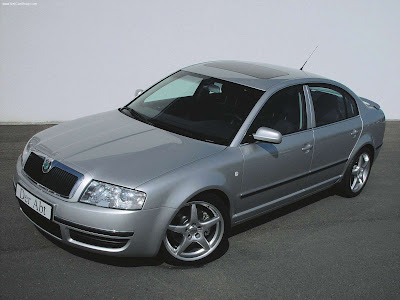
The first Superb-models were equipped with impressive eight-cylinder engines, with a capacity of up to 6.6 litres in the past, Skoda is now following the sign of the times and offers a range of petrol and diesel engines for the new generation. An ideal playing field for Abt Sportsline's engineers. Thanks to optimising the electronic engine management, they boosted the 1.8 litre turbocharged engine from 110 kW (150 bhp) to 142 kW (193 bhp). The company has developed performance improvement kits for two diesel engines as well: power of the 1.9 litre TDI-engine has been increased from 96 kW (130 bhp) to 114 kW (155 bhp), and, after a visit to Kempten, the 2.5 TDI engine delivers 132 kW (180 bhp) instead of the previous 114 kW (155 bhp).To get the power of the Abt Superb on the road in the best possible way, clients at Abt Sportsline have a wide range of top-class light alloy wheels to choose from. The portfolio ranges from 7 x 15 inch to the A 27 model of 9 x 19 inch. All wheels have the unmistakable classic five-spoke-design and the high quality of the designer from Kempten.

ABT Skoda Fabia (2002)

ABT Skoda Fabia (2002)
The Skoda Fabia enjoys a strong following - however, at Abt Sportsline the compact car is given even more of a sporty appearance.As the world's leading customizer of brands of the Volkswagen Group, the Kempten-based enterprise developed a range of ideas for the small member of the VW family. The model which featured for the first time during the Automobil International fair in Leipzig in April 2001 was not only tuned optically with frontspoiler lip, rear wing and noble interior, but also with a power boost to 92 kW (125 hp).With its standard 74 kW (100 hp) engine, the Skoda Fabia 1.9 TDI is extremely agile, nevertheless the Abt technicians give the compact Czech car even more sportiness. Thanks to Abt tuning, the power output of the turbo-diesel DI engine is boosted to 108 kW (125 hp).The springs lower the vehicle by around 35 to 40 millimetres.A real eye-catcher is the polished silver gearshift knob with the matching Abt aluminium pedals for manual and automatic gearboxes, as well as floor mats sporting the distinctive Abt logo.Abt offers steel-braided brake linings which deliver a constant and optimal braking point of pressure and require less pedal force. Abt Sportsline offers this complete package for the Skoda Fabia with a type approval. The advantages: The braking force is more sensitively controllable, the braking distance is shortened, and the system also ensures an optimal protection against stone impact and abrasion.

Skoda Octavia RS, 2010

Skoda Octavia RS, 2010


The facelifted Skoda Octavia RS has a redesigned front mask with an RS logo and bold headlamps that, can be fitted with xenon units combined with an adaptive front lighting module.
Besides a wider and bolder induction aperture, the car's innovated bumper boasts a further two innovations: fog lamps with the Corner function and LED lamps for daytime lighting.


The covers of integrated tailgate lamps have been redesigned to look more attractive, other innovations include, for example, a new metallic paint (Anthracite) and 18" Neptune wheels.
The sports-tuned chassis has been lowered to 127 mm, the car's weight reduced by 20 kg in the petrol version and 15 kg in the diesel one.
Significantly reduced air resistance has a positive impact upon the car's overall performance.
The maximum speed is higher, and the car's responsiveness and acceleration have also been improved.


Skoda Superb, 2009

Skoda Superb, 2009


The presentation of the new �koda Superb was accompanied by great expectations. Not only the potential and the success of its predecessor have set the sights at a high level, tradition itself is an obligation. It should be remembered that there was already a magnificent car with the name of Superb, bearing the �koda badge back in the thirties and forties. Even at that time, the car strengthened the reputation of the long-established Czech company as being among the best car manufacturers in the world. When it was launched in 2001, the first modern �koda Superb represented a new start, a re-entry into a segment of the market that had been neglected throughout the difficult years of the planned, Communist economy.

In masterly fashion it put them in their places and was successful in comparison with, among others, the Mercedes-Benz E-Class, the Peugeot 607, the Alfa Romeo 166, the Renault Laguna and the Jaguar S-Type. In a test involving the �koda Superb V6 2.8 the magazine Auto, Motor and Sport described the car under the headline �Czech Example", referring to the absolutely unbelievable price-performance ratio of the spacious medium segment saloon - one that none of its competitors could hold a candle to. The top of the range model from �koda has even established itself in the very conservative fleet market sector where normally only cars from brands already established in the fleet market are found.

The interior
In spite of being almost identical in overall length to the previous generation �koda Superb, the new Superb exceeds the already generous interior measurements of its predecessor in almost all aspects thanks to the transverse engine design. This begins in the front, where space has been gained by moving the gear position. The central tunnel has been designed in a much leaner form. And, in the rear, the knee space has been increased by 19 millimetres, affording the passengers unique travelling comfort. The new �koda is 4,838 millimetres in length, 1,817 millimetres in width and has a height of 1,462 millimetres.

The interior, with its finely tuned mix of materials and excellent workmanship, satisfies the needs of even the most demanding customer. The dashboard with its wave-shaped design groups the operating elements into sensible individual functional units. All of the primary functions are concentrated around the steering wheel and quick access is guaranteed because of the logical location. Thanks to the unique design, erroneous operation is practically eliminated. In certain trim levels, the steering wheel includes multi-function buttons for the operation of the radio unit, MFA and a mobile phone. Chrome inlay in the centre of the newly designed, leather wrapped steering wheel reflects the clear V-shape form of the car's front.

Premiere for an automotive advance: the Twin-door concept
The shape of the bodywork, with its balanced proportions, the timeless elegance of its lines and the stylistic elements which combine to make �koda automobiles unique, incorporates a new feature that will once again become the benchmark in the automotive world. Although the design in this class has retained the traditional hatchback concept, the new �koda Superb now has a tailgate which places practically no limits on what can be transported. The unique, patented "twin door" variable boot opening, designed by engineers at �koda, offers an extremely practical, functional and well thought out solution. Depending on what is required, either only the boot lid alone can be opened when smaller items are to be stored.
The boot is fitted with high-quality carpeting. Below the solid base plate there is further space for storing personal objects, and underneath this is the spare wheel (except in the case of the GreenLine versions). There are eyelets at the side of the boot space to secure goods being transported while practical folding hooks provide perfect hold for shopping bags.

Always safe in its stride: the chassis of the new �koda Superb

The chassis of the new Superb uses �koda's modular strategy - it uses modules from the �koda Octavia (VW Golf) and Volkswagen Passat chassis. However, �koda has taken these modules, adapted them and added new elements, giving the car its own driving character. The MacPherson wishbone front suspension is housed in an aluminium axle to provide greater kinematics while simultaneously reducing axle weight. The �koda Superb's suspension system increases driving comfort and reduces tyre noise.

The �koda Superb has a completely new form of coordination between the ABS and ESP systems. The object of the development was to provide the new �koda Superb with commanding and comfort-oriented properties without limiting driving pleasure in any way. "And, we have achieved this target, across the entire range" says Dr. Eckhard Scholz, Board Member for Technical Development at �koda Auto. Careful adaptation of the individual chassis components gives the new Superb properties which are every bit as exciting as they are balanced and safe even in critical situations.

Premiere for intelligent lighting: AFS for the �koda Superb
Best visibility is created not only by the generously proportioned front windows and the marked increase in the size of the exterior mirrors of the �koda Superb but also by the Superb's new headlight system. AFS (Adaptive Front Light System) clearly improves visibility, adapting to the driving conditions and enabling the driver to recognise obstacles in the road sooner and to react quicker.

No compromises: safety on all roads
Passenger protection in the new Superb is of the highest level. Depending upon equipment level and version, there are up to nine airbags on board. Two front and side airbags as well as head airbags at the front and back provide all-round protection. The knee airbag for the driver and the side airbags in the rear are completely new. Anti-spin regulation (ASR) is standard in all versions of the new �koda Superb. Pedestrian protection measures reduce the danger of injury considerably in the case of an accident. ESP and ABS with Brake Assistant are part of the standard equipment depending on country. The hill hold function facilitates starts on hills and prevents the car from rolling backwards when the brake is released.

State-of-the-art technology under the bonnet: the engine range
The range of engines for the new �koda Superb fulfils the needs of every customer and presents a wide-ranging variety. There are three petrol and three diesel engines available. All of the engines operate with direct fuel injection and excel as a result of their low fuel consumption and emission values.

The weight of �koda's top model weighs from only 1,425 kg so that even the basic engine models have no problem in providing plenty of power.

The basic diesel engine is the 1.9 litre TDI PD, providing an economically-priced but nevertheless powerful entry into the �koda Superb program. The four-cylinder provides 77 kW (105 HP) and reaches its torque peak of 250 Nm at 1,900/rpm. With an average fuel consumption of 5.7 litres per 100 kilometres and CO2 emissions of 151 g/km, it provides both excellent fuel economy, low emissions for its size. Nevertheless, the driving characteristics are impressive: this model reaches a top speed of 190 km/h and the basic diesel engine accelerates from 0 to 100 km in 12.5 seconds. A manual five-speed gear transmits the power to the front wheels.

Direct injection is available in all petrol versions. The TSI 1.4 litre, four-cylinder version is making its debut in the �koda Superb where, despite its small capacity, it nevertheless provides 92 kW (125 HP) and 200 Nm torque peak at a level of 1,500 to 4,000/rpm. Only 10.5 seconds are necessary for the small, powerful engine to accelerate the new Superb from 0 to 100 km/h, while top speeds of up to 201 km/h are possible. Thanks to the down-sizing concept, the consumption for this petrol engine drops to the extremely favourable figure of 6.6 litres of fuel per 100 kilometres. The combined CO2 emission is at a figure of 157 g/km.

Of a high standard but not unattainable: the equipment
The equipment in the three trim levels, Comfort, Ambition and Elegance, is of a high level. In addition, there is an extensive package of additional equipment available. Rain sensors, Light Assistant, Bi-Xenon headlamps with AFS, tyre pressure monitoring, braking and hill-hold assistant as well as parking assistant and a parking steering aid are only some of the additional features offered. The parking assistant works with a 4/8 sensor system; the parking steering aid has been developed by the Volkswagen Group and has been adapted especially by �koda Auto to comply with the demands in the new �koda Superb. It assists the driver when manoeuvring into a parking space.

The electronic package leaves practically nothing to be desired. The features range from a high-tech navigation system with touch screen function and hard disc storage through to a top-class audio system with powerful high-end loudspeakers, CD player with MP3 connectivity in the Jumbo Box for external storage media or a card reader. All of these components are harmoniously integrated into the wave-shaped dashboard.


Skoda Octavia RS

The facelifted Skoda Octavia RS has a redesigned front mask with an RS logo and bold headlamps that, can be fitted with xenon units combined with an adaptive front lighting module.
Besides a wider and bolder induction aperture, the car's innovated bumper boasts a further two innovations: fog lamps with the Corner function and LED lamps for daytime lighting. The covers of integrated tailgate lamps have been redesigned to look more attractive, other innovations include, for example, a new metallic paint (Anthracite) and 18" Neptune wheels.
The sports-tuned chassis has been lowered to 127 mm, the car's weight reduced by 20 kg in the petrol version and 15 kg in the diesel one.
Significantly reduced air resistance has a positive impact upon the car's overall performance.
The maximum speed is higher, and the car's responsiveness and acceleration have also been improved.