A sporty crossover with a flowing and athletic body language, it conjures up visions of two people exploring the world and previews a forthcoming road car. Its Energy dCi 160 twin-turbo engine-concept combines driving fun, enjoyable performance and low CO2 emissions.
At the 2009 Frankfurt Motor Show, Renault revealed its new brand identity which puts people at the forefront of its concerns. The new and ambitious design strategy which resulted from this is founded on different stages of the human life cycle, with each phase taking the form of a specific concept car. The first, the two-seater DeZir coup�, expressed �falling in love�, the passion present at the beginning of any new
adventure. Now Renault CAPTUR addresses the second phase of this cycle, that of two people exploring the world around them. Just like its predecessor, Renault CAPTUR defines the simple, sensuous and warm style that will be progressively extended to future Renault car designs
In its proportions and fluid curves, Renault CAPTUR evokes movement and lightness, yet at the same time displaying powerful and muscular all-terrain cues. Just as with DeZir, angles, corners and lines have given way to sensuous and natural forms. For the exterior designer, Julio Lozano, the main sources of inspiration were athletes and radical sports. �In designing CAPTUR, I began with the image of a sprinter on the starting
blocks, his muscles tensed, and the energy unleashed when the starting pistol is fired,� he explains. The design also references equipment such as helmets, gloves and other protective gear used in radical sports, combining high technology with sophistication and lightness.
Renault Samsung SM7 use a Nissan VQ engine with six-speed automatic with manual shift function that include a high-capacity torque converter. Renault Samsung SM7 offers two engine options, 3.5 VQ (six-speed automatic transmission with manual gearshift mode) or 2.5 VQ (six-speed automatic transmission with manual mode selector). 2.5 VQ engine has maximum power of 190hp achieve increased 15 percent over the previous SM7, while peak torque of 243Nm at 4,400 rpm on the stand, and 3.5 VQ engine produces maximum power of 258hp (up more than 20% over the previous SM7). Peak torque of 330Nm produced at 4,400 rpm. Fuel consumption is 10.4 litres/100km low. All-New Renault Samsung SM7
With a power output of 265hp and peak torque of 360Nm, Megane RS Trophy delivers unrivalled efficiency for its class. A new tyre fitment and an increase in power make the very most of the Cup chassis' potential, without detracting from the car's acclaimed versatility and ride comfort.
A production run of 500 cars is planned, and Megane RS Trophy's specific styling features put it at the very top of the Megane RS range.
Order books open on June 20, 2011, and the newcomer will be marketed in France, the United Kingdom, Germany, Belgium, Portugal, Spain, Italy, Switzerland, Austria and Slovenia. Prices in France will start from �35,500.
Technical evolutions for the existing, exceptional performance package
With maximum power of 265hp (up 15hp), peak torque of 360Nm (+20Nm) available across a particularly broad rev-band (3,000 to 5,000rpm), a power-to-weight ratio of 5.09kg/hp and specific power of 132.5hp/litre, the car boasts an exceptional performance package. Even so, Renault Sport's engineers have worked hard on the specification of the Megane RS's 2.0-litre turbocharged engine to take driving enjoyment and response to even higher levels. Maximum turbo pressure has been uprated to 2.5 bar (up 0.2 bar), while the air intake design has been revised to take the higher pressure and higher running temperatures into account.Performance has been enhanced in the process, and the result is a 0-to-100kph time of just 6.0s (down 0.1s), a top speed of 254kph (up 4kph) and the 1,000km standing start in 25.4s (down 0.3s). Beyond these statistics, however, the experience of driving Renault RS Trophy is a constant source of enjoyment and satisfying sensations. In addition to the finely-tuned set-up of the Cup chassis and the standard limited slip differential, a new tyre fitment contributes to the car's exceptional road-holding on dry roads, especially through tighter turns, as well as in the wet. The design of the Formula 1-inspired Bridge stone Potenza RE050A's asymmetric, directional tread pattern and the form of its tread blocks provide outstanding grip, stability and acoustic comfort, whatever the conditions. Last but not least, Megane RS Trophy's fuel-efficiency has been carefully optimised to return combined-cycle fuel consumption of just 8.2 litres/100km, equivalent to 190g of CO2/km, which represents a saving of 0.2 litres/100km and 5g/km over 2012 Renault Megane RS at the time of the letter's launch.
Assertive yet seductive R.S Trophy. styling cues
2012 Megane RS Trophy is recognisable at a glance thanks to its black roof, specific decals, new rear lip spoiler, 19-inch Gloss Black STEEV wheels with red piping and R.S. valve caps (optional or standard, depending on market) and numbered plaque. The LED daytime running lights also play a part in its striking looks. Trophy marks the introduction of a new Sirius Yellow finish, an emblematic metallic paint that will be particularly appreciated by Renault Sport fans. This specific body colour is available as an alternative to Glacier White, Etoile Black and Cassiopee Grey.
Inside, the Recaro bucket seats (fabric or leather, depending on market) add to the cabin's unmistakably sporty feel, as does the central display which shows the data provided by the R.S. Monitor. This innovative on board data-logging system records performance and displays a range of mechanical parameters in real-time, a feature which owners will especially appreciate during track days, an exercise to which the Trophy lends itself particularly well. Indeed, the car will be on show at the Renault Sport Day which forms part of the Renault Sport Enthusiasts Day programme at the Nurburgring, Germany, on June 17, 2011.
The Renault DeZir project is the first to have been led by Laurens van den Acker and marks the start of a sequence of concept cars that will provide an insight into Renault Design's new vision for the future. DeZir stands out as an illustration of the brand's commitment to more emotional styling.
The DeZir Electric is a two-seater coup� that Renault says stands out as an illustration of the company�s commitment to more emotional styling. With its sports car looks and ability to accelerate from 0 to 100 km/h (62mph) in five seconds, or 0 to 50 km/h in just two seconds, it�s hard to disagree.
Although the DeZir is purely a concept car at this point, Renault is strongly hinting that it shows not only the direction they plan on heading with sports cars in the future, but that it is indicative of a new overarching design and styling philosophy across the entire Renault brand.
The 'Z' in the name DeZir is a direct reference to Renault's Z.E. signature, and several features of its design are suggestive of two qualities readily associated with electric mobility, namely advanced technology and light weight.
DeZir Electric is powered by an electric motor mounted in a mid-rear position to optimize weight distribution over the front and rear wheels. The vertically-mounted 24kW/h lithium-ion battery is located behind the benchseat and provides the car with a range of 160km.
Battery cooling is ensured not only by the air channelled from the front to the back of the car, but also � and above all � by the flow of air that enters through the lateral scoops concealed behind the aluminium panels on either side of the body.
Employing the same principles as the KERS (Kinetic Energy Recovery System) seen in Formula 1, when the car decelerates, kinetic energy is recovered and stored in the battery. This energy can then be employed by the driver to provide a temporary power boost using a button located on the steering wheel. The car can be charged in 8 hours at 240-v, can get to 80% charge in 20 minutes at 4o0-v (3-phase) and will accept battery swapping made possible by the Better Place alliance.
The basic motor is the same as the unit used for Renault's production electric cars, although an evolution has enabled its power and torque to be uprated to 110kW (150ch) and 226Nm respectively. Through the extensive use of lightweight materials such as the Kevlar body, the DeZir Electric tips the scales at just 830kg or 1,830 pounds. According to the French carmaker, the DeZir can go from zero to 100km/h (62mph) in 5 seconds and reach a top speed of 180km/h or 112mph.
The DeZir will debut in October at this year's Paris Motor Show, but no date has been set for its full release. According to Fast Company, by the end of 2013 the Renault-Nissan alliance hopes to produce 500,000 electric vehicles globally, including the 2011 Fluence ZE and the 2011 Kangoo ZE electric van.
Don't let anyone tell you that Renault can't do a concept car. The French manufacturer pulled the sheets back on its all-electric Dezir at this year's Paris Motor Show, and the concept is as sexy as it is absurd. Designers took a stab in an all-new direction with a pair of reverse-hinged butterfly doors that are the epitome of awesome. Likewise, the ultra-wide stance and aluminum sideblades are our kind of flashy. As you might expect, this concept makes use of a fittingly-futuristic powertrain. Renault says that under all of that curvy sheet metal there's a full EV drivetrain on hand.
Surprisingly enough, there isn't supercar-rivaling power on hand, though. The company puts the Dezir final horsepower figure at around 150 ponies and 166 pound-feet of torque � not exactly e-tron rivaling numbers. Even so, the concept is said to be able to dart to around 60 mph in just shy of five seconds.
Let the flood gates open wide and the deposits pour in, Renault is officially accepting pre-orders for it 2011 battery-powered Fluence Z.E. Yep, it's another momentous day for the Renault-Nissan Alliance and it just so happens that the automaker choose the grounds of the Paris Motor Show to announce that its electric sedan is ready to roll. Well, almost. Buyers in France, Israel and Denmark will get first crack at piloting their own Fluences by the middle of next year, but first they'll need to place a pre-order ASAP.
Customers who wish to take ownership of the Fluence Z.E. are asked to register at Renault's website and put down a �100 deposit ($137 U.S. at the current exchange rate). Priced at �21,300 ($29,279 U.S.), the Fluence Z.E. might seem like a raging value, but let's not forget that Renault has decided to lease the battery pack separate of the vehicle. Add in another �79 ($109 U.S.) in monthly battery lease fees and what was once a killer deal no longer seems like quite as much of a bargain. However, the Fluence's sticker price still does far less damage to the checkbook than its European competitors like the Nissan Leaf and Mitsubishi i-MiEV, so we'd expect the electrified Fluence won't have any trouble finding eager buyers.
Earlier this year, the 2011 Renault Latitude was unveiled at the Moscow International Auto Show. The European version has now made its debut in front of the crowd at the Paris Motor Show. The Latitude is considered a business-class saloon and Renault is positioning it to become the automaker's flagship vehicle.
The styling of the Renault Latitude somehow evokes images of the Chyrsler Sebring, new Volkswagen Jetta and any Lexus vehicle � yet it's done in a stylish manner. When it launches in Russia, the Latitude will be available with either a 139-horsepower, 2.0-liter four-cylinder engine paired with a CVT or a 2.5-liter V6 mated to a six-speed automatic that's good for 177 hp. The four-cylinder unit is rated at 34 miles per gallon while the V6 gets just under 30 mpg. As the car expands into other markets, it will feature an expanding lineup of engine and gearbox choices.
Inside, the Renault Latitude is all about comfort. The power-adjustable driver's seat features a massaging function with five pneumatic rollers and four different settings. In order to keep everyone else happy, the Latitude has a climate control system with triple-zone adjustability.
The 2011 Renault Latitude hit dealer showrooms in September 2010, in Morocco and Algeria. It then starts popping up in Russia and the Ukraine before being made available throughout Africa. The European model will follow after that.
Believe it or not, Renault says the car you see above, known � seriously, we're not making this stuff up � as the Twizy, is a production vehicle. We hesitate to call it a car, or a motorcycle, or a scooter... it's really sort of a four-wheeled covered scooter, and it's powered by an electric drivetrain.
There will apparently be two different versions of the Twizy available, one sporting nine horsepower that can hit a top speed of 28 miles per hour and one with 20 horses that can hit 47 mph. A three-and-a-half-hour charge will result in 60 miles of range from the onboard lithium ion battery pack.
Renault is currently taking pre-orders on the Twizy, along with two other electric vehicles, and it will have the vehicle on the market in Europe by the end of 2011. Pricing is expected to be similar to the Piaggio MP3, and the rental charges for the battery pack will be covered in the Twizy's payment.
Renault Zoe ZE Concept targets motorists who own more than one car and who are looking for a compact, versatile vehicle capable of meeting their varied day-to-day needs, such as the school or work run, or shopping trips.
Renault Zoe ZE Concept is an all-electric, zero-emission vehicle which reconciles motoring with the environmental aspirations of customers looking for a vehicle with the best possible ecological footprint.
Hydrating function. In contrast to conventional climate control systems, which can tend to dry out the air, small dashboard-mounted vaporizers spray an exclusive active substance to rehydrate the skin and exude a sensation of wellbeing.
'Detox' function. A toxicity sensor monitors air quality and shuts off the airvents if required. Then, in addition to extracting harmful substances, the cabin filters deliver others which benefit the skin.
Active scent function. An electric system exhales essential oils suited to the mood of the moment: something mellow for a relaxing drive home, perhaps, or the need to stimulate concentration when driving at nigh.
MOTOR
; * Type: Electric
; * Transmission type: Direct drive with forward/reverse inverters
The Renault DeZir project is the first to have been led by Laurens van den Acker and marks the start of a sequence of concept cars that will provide an insight into Renault Design's new vision for the future. It also lays the foundations for the styling cues of Renault's forthcoming vehicles.
AN ELECTRIC BEAUTY
Renault DeZir is powered by an electric motor mounted in a mid-rear position to optimize weight distribution over the front and rear wheels. The vertically-mounted 24kW/h lithium-ion battery is located behind the benchseat and provides the car with a range of 160km. Battery cooling is ensured not only by the air channelled from the front to the back of the car, but also - and above all - by the flow of air that enters through the lateral scoops concealed behind the aluminium panels on either side of the body. The basic motor is the same as the unit used for Renault's production electric cars, although an evolution has enabled its power and torque to be uprated to 110kW (150ch) and 226Nm respectively.
Three battery-charging methods can be employed:
* a standard charge using a conventional household plug (fully charges the battery in eight hours).
* a fast charge using a 400V three-phase current (charges the battery to 80 per cent of its capacity in 20 minutes).
* a fast battery exchange thanks to Renault's Quick Drop technology.
Dimensions
* Length: 4,225 mm
* Width: 1,968 mm
* Height: 1,163 mm
* Height, with doors open: 2,256 mm
* Width, with doors open: 2,682 mm
* Ground clearance: 110 mm
* Wheelbase: 2,582 mm
* Front track: 1,600 mm
* Rear track: 1,705 mm
Technical data
* Motor: Electric synchronous motor with rotor coil
* Power: 110 kW / 150 hp
* Maximum torque: 226 Nm
* Top speed: 180 km/h
* Acceleration 0-100 km/h: 5 seconds
* Acceleration 0-50 km/h: 2 seconds
* Battery: Lithium-ion (24 kW/h)
* Range: 160 km
* Transmission: Rear-wheel drive; Direct, drive, with reducer and forward/reverse inverter
* Drive: Electric with active differential
* Chassis: Tubular steel frame
* Wheels and tyres: 245/35 R 21
* Diameter of ventilated brake discs: 356 mm (front and rear)
According to an unnamed source, the Renault board of directors has called an extraordinary meeting on Tuesday, April 6th, to discuss plans to enter into an agreement with German automaker Daimler. As was the case when Renault teamed up with Japanese automaker Nissan, there will reportedly be an exchange of stock, but not nearly at the same level as Renault's 44-percent stake in Nissan.
If the board chooses to move forward � and all indications are that it will � an announcement could be made as early as Wednesday detailing the partnership. It's widely thought that Daimler is keenly interested in Renault's small car expertise for its less-than-wildly-successful Smart car division, and it seems increasingly likely that the two automakers could jointly develop new city car platforms. Might a more family-friendly ForFour be in the offing as rumored?
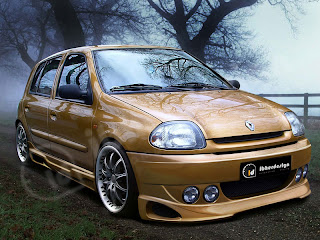
Renault Clio2009 The 2009 Geneva Motor Show sees Renault take the wraps off the latest hatchback and estate versions of the best-selling Renault Clio. New Renault Clio's styling, comfort, versatility, safety credentials and equipment, which form a package worthy of that of models from the next segment up, are sure to appeal to a large, loyal customer base worldwide. At the same time, its extremely rigorous build quality makes it one of the most reliable cars of its class.
A compact hatchback with clear family ties with New Renault M�gane
New Renault Clio GT, a more purposeful personality Styling: New Renault Clio GT can be recognized by its exclusive Malta Blue body colour and expressive, racy lines. It sits squarely on its 16-inch "Dark Anthracite" aluminium alloy wheels, while its more assertive front end features a gloss black grille and distinctive black headlamp masks. The lines of the sills point to the performance of the GT version's specific suspension. Meanwhile, the twin exhaust tailpipes and rear lip spoiler underline New Renault Clio GT's undeniable sports tourer looks. Inside, eye-catching sporty details include drilled aluminium pedal covers and extra side support for the seats, as seen on New Clio Renault Sport, plus GT-badging for the front seats.
Suspension: Renault Sport Technologies' engineers have paid special attention to ensure that New Renault Clio GT's chassis combines first class dynamic ability with a comfortable ride.
Powertrains: the GT version is available with a choice of three engines (depending on market): the 1.6 16V 128 (exclusive to New Renault Clio GT), the 2.0 16V 140 and the dCi 105. They all drive through the TL4 six-speed gearbox. Carminat TomTom: the first updatable, integrated GPS navigation system for less than �500
New Renault Clio's interior styling: perceived quality and user friendly New Renault Clio's interior styling was guided by a desire to provide a sense of well-being and perceived quality. The dashboard is available with a soft-touch finish and incorporates clear, easy-toread instruments, while the fully-integrated screen of the Carminat TomTomsatnav system is positioned at the top of the centre console. New Renault Clio is a car in which drivers feel immediately at home. The practical controls have been made even more user-friendly, including the short steering wheel-mounted stalks. The switch for the cruise control and speed limiter has been moved to the centre console, alongside the parking brake, and the dashboard display permits drivers to check whether the cruise control/speed limiter is activated or not. Grand tourer quality acoustic performance New Renault Clio claims soundproofing performance from the next segment up. Its architecture has been carefully engineered to filter out engine and transmission-generated noise, as well as road noise. Care has also been taken with the sound damping between the cabin and the engine, while wind noise has been reduced thanks notably to the use of inflatable inserts in the structure's hollow sections.
Efficient suspension performance for a comfortable, reassuring ride The New Renault Clio family delivers a carefully-honed balance between rigorous, comfortable and safe handling. The suspension has been developed to meet the expectations of the customers of the different versions (Hatchback, GT, Estate). The suspension of New Renault Clio Hatchback is identical to that of Clio III and provides a high standard of efficient, comfortable roadholding. Compared with the hatchback version, New Renault Clio Estate is equipped with a bigger-diameter rear anti-roll bar (21mm) for enhanced control of body roll. Its dampers and suspension travel have also been adapted to match the estate version's heavier weight and extra carrying capacity. Responsive, environmentally-friendly engines The range of engines and transmissions has been carefully selected to bring out the best in New Renault Clio's dynamic performance. These powertrains are respectful of the environment, too, thanks notably to:
* a choice of dCi engines, two of which emit less than 120g of CO2/km (e.g. the dCi 85: 117g of CO2/km) and the availability of a particulate filter for a certain number of them, * the TCe 100, which boasts the lowest CO2 emissions of any 100hp petrol engine, * a 1.2 16V engine capable of running on alternative fuels, namely an E85 bioethanolcompatible version and an LPG version.
A raft of equipment from the next segment up The New Renault Clio range includes a long list of equipment from the next segment up aimed at either facilitating driving or enhancing travelling comfort. New Renault Clio is the only B-segment model that can be ordered with a hands-free card. To unlock the car, the driver only has to put a hand near one of the door handles, or else activate the boot opening mechanism. The doors automatically lock at the push of a button situated on the driver's door. A remote lighting function enables owners to locate their vehicle at a distance thanks a bespoke button on the card which activates the lights. For hands-free starting, the card doesn't need to be inserted into a slot; its mere presence inside the cabin suffices thanks to special antennae. The new Renault Clio comes with the new 80W RadioSat Classic audio system which includes six loudspeakers, an MP3-compatbile CD player, the display of MP3 file names and an RCA socket situated in front of the gear lever.
The Bluetooth function permits hands-free use of the telephone using the vehicle's own loudspeakers for enhanced safety. The system automatically detects the telephone when the driver starts the car, while Renault's exclusive 'hold' function puts callers on hold until the driver is in a position to answer safely. Incoming and outgoing calls automatically mute the radio and the telephone's functions are controlled via the steering wheel-mounted controls in conjunction with the dashboard display or Carminat TomTom screen.
The Bluetooth function also incorporates audio streaming, in other words the wireless transmission via the vehicle's own loudspeakers of personal playlists stored on A2DPcompatible portable players. Other equipment For enhanced comfort and safety, New Renault Clio is equipped with the follow equipment : * cruise control with speed limiter, * additional cornering lights * rear parking proximity sensor, * a combined rain/light sensor which automatically switches on the headlamps and/or activates the windscreen wipers at the ideal wipe-speed.
Safety: a priority for Renault, and a self-evidence for New Renault Clio The New Renault Clio family benefits from Renault's extensive expertise when it comes to active and passive safety. The combination of New Renault Clio's suspension and a range of driver aids (ABS with electronic brakeforce distribution, emergency brake assist, ESC, traction control, engine torque overrun regulation) ensures an outstanding level of active safety.
The Renault has chosen the Geneva Motor Show to take the wraps off its M�gane Coup� Concept show car which foreshadows a compact production coupe to be released at a later date. Like New Laguna, it points to an evolution towards more fluid, sportier styling from Renault. Renault M�gane Coup� Concept targets drivers who are not only drawn by the notion of driving pleasure but who also seek to express their personality through their vehicle. M�gane Coup� Concept symbolizes Renault's vision of what a genuine compact sports coupe should deliver, namely character and dynamism, two traits epitomized by the show car's unprecedented door-opening kinematics.
Distinctive looks that exude personality and dynamism
The Renault M�gane Coup� Concept provides a foretaste of the forthcoming M�gane Coupe. "This show car emphatically showcases the evolution at Renault Design. Its squatter proportions and powerful, energetic styling talk directly to the driver's senses; they say 'driving pleasure'. The spectacular, unprecedented door-opening kinematics add that little touch of magic which contributes to the dream factor associated with the automobile," explains Renault's Patrick Le Qu�ment, Senior Vice President, Corporate Design. Of a total length of 4.51 metres, Renault M�gane Coup� Concept features a modern, dynamic silhouette with taut lines that seem to suggest perpetual movement, while its alert, expressive front-end looks point at once to a truly dynamic personality.
The juxtaposition of headlamp modules with aluminium-finish air-intakes also conveys an impression of fluidity and movement. The two rows of main and dipped beam lights sit on a crystal-like striated strip which fills the sidelight and daytime running light functions. The headlamps use high-performance light-emitting diodes which are both long-lasting and extremely efficient. The foglamps also employ LED technology and blend harmoniously with the dynamic, front-end styling. The shoulder-lines flow along the curvaceous sides before culminating in a squat rear-end which expresses power and movement.
The boot, which pulls open and then lifts to minimize vertical travel, echoes the kinematics of the doors which are divided into two sections. The panelled door itself is topped by a separate glazed area and, as they open, the two parts deploy gracefully and elegantly in an independent movement redolent of dragonfly wings. A carbon arm at the rear of the doors connects them to the body structure and the system ensures particularly easy access for passengers.
The cabin: a compelling extension of the exterior's dynamic voluptuousness
The interior is redolent of the world of contemporary furniture. The independent, asymmetric front seats, which rise up from the sills, seem to float in midair. Their wafer-like forms express an airy lightness, while their enveloping design is a pledge of comfort and holds the occupants firmly in place. The aperture revealed by the open doors carries over to the front seat shells and the upper part of the two rear seats. This sculptural, one-piece structure, which is finished in fire red lacquer, ensures a seamless link between the exterior and the cabin. The centre console extends through to the rear seats and its layered design recalls the striated bar of the headlamp modules.
The choice of colours and materials is another means by which the exterior and interior have been harmonized to highlight Renault M�gane Coup� Concept's volumes and magic. The iridescent Dragon Grey body-colour goes well with the dragonfly-like door-opening mechanism and the paintwork's rainbow finish gives a fresh vision of the car every time the light changes: even at a standstill, it appears to be in movement. Meanwhile, the interior's contrasting colour-scheme underpins the dynamic exterior thanks to the blend of fire red lacquer (dashboard, upper part of the centre console, front seatbacks, etc.) and softer black leather or nubuck for the door panels, seat cushions and centre console). The door panels themselves incorporate supple, slide-locking stowage, while the floor is protected by a black, modern, graphic mesh.
The cabin equipment is modern and intuitive
The different controls have been inspired by the Renault-pioneered Touch Design approach and are both simple and practical. The central multimedia control is coupled with a display divided into three zones. The central part displays all journey-related information (navigation, radio, music, video, Bluetooth telephone), while the screens either side show the images relayed by cameras incorporated in the exterior mirrors. Renault M�gane Coup� Concept is locked and unlocked using a Samsung F700 mobile phone which serves as a hands-free card and connects to the centre console. Both rear passengers benefit from a portable Samsung P2 audio/video multimedia player with touch screen which they can use to swap files using the mp3/video Bluetooth controls. The four-zone climate control system allows each passenger to select the temperature they prefer using controls housed either side of the dashboard in the case of the front passengers or on the front seatbacks for rear occupants. Special care has also gone into ensuring that the cabin is brightly lit. The red backlighting of the instruments contrasts with the surrounding black backgrounds. Meanwhile, the panoramic windscreen extends over the roof to provide additional clarity during the day and blue-hued cabin lighting at night.
A show car dedicated to passion and driving pleasure
Renault M�gane Coup� Concept's generous bumper, wide, low grille and alveolar air-intake point to the presence of a high-performance powerplant under the bonnet. Indeed, Renault M�gane Coup� Concept is powered by a 200hp (147kW) 2.0 Turbo petrol engine which delivers torque of 280Nm at 2,600rpm and peak power of 200hp at 5,800rpm to ensure punch and flexibility at all engine speeds for everyday motoring pleasure. Mated to a manual six-speed gearbox, the 2-litre turbocharged unit drives Renault M�gane Coup� Concept from a standstill to 100kph in just 7.2 seconds, yet it returns economical fuel consumption of just 6.5 litres/100km (154g of CO2/km).
Renault M�gane Coup� Concept is a compact, stylish, dynamic coupe which delivers undeniable driving pleasure, while its sporty calling is also expressed by its modern, elegant cabin. This show car, which builds on the trend established by Laguna Coup� Concept, sees Renault take its will to dial genuine passion into its cars yet another step forward.
Dimensions * Length (mm) 4,514 * Width (mm) 1,908 * Height (mm) 1,371 * Height with doors open (mm) 2,085 * Wheelbase (mm) 2,749 * Front track (mm) 1,658 * Rear track (mm) 1,648 * Front overhang (mm) 950 * Rear overhang (mm) 815 * Unladen weight (kg) 1,310 * Boot volume (litres) 290 Technical data * Engine 2.0 T petrol (200hp) * Power (hp) 200hp (147kW) * Maximum torque (Nm) 280Nm at 2,600rpm * Acceleration from standstill to 100kph (s) 7.2 * Standard cycle CO2 emissions / fuel consumption 154g/km / 6.5 litres/100km * Gearbox Six-speed manual gearbox * with 'stop and start' system * Transmission Front-wheel drive * Tyres 245/35 ZR21 * Wheels 21-inch
For 2011, Renault is launching an all-new version of its Megane coupe-convertible. Like the last generation model and most of its European market competitors, the Megane gets a folding hardtop, but somewhat like its competitor the Volkswagen Eos, this one lets the sun shine in even when closed. The Megane gets an all-glass roof, which, while letting you see the world, will probably do nothing to help the car's center of gravity. On the other hand, the black finish does help to visually hide the roof when it is raised, a stylistic windfall that partially alleviates the peculiar proportions of such hardtop convertibles. That said, this doesn't really appear to be a high-performance proposition, so we're guessing that more potential customers won't care about the extra weight up top anyhow.
To its credit, Renault has managed to retain a surprisingly large trunk on the Megane with 14.7 cubic feet top up and even 7.45 cubic feet available with the top down. The Megane has seven powertrain configurations available with six gas and diesel engines combined with manual, dual clutch and continuously variable transmissions.
The new Megane coupe-convertible goes on sale in Europe this spring.
[Source: Renault]
PRESS RELEASE February 5, 2010 NEW ME�GANE COUPE�-CABRIOLET, THE ELEGANCE OF A COUPE�, AND THE ENJOYMENT OF OPEN-TOP MOTORING
New Me�gane Coupe�-Cabriolet rounds off the renewal of the New Me�gane family in style with introduction of the line-up's sixth body type. The newcomer's striking looks combine the elegance of a coupe� with the promise of the thrills that go hand-in-hand with driving a cabriolet.
New Me�gane Coupe�-Cabriolet builds on the strengths that forged the success of its predecessor � including a large, folding glass roof and a raft of user-friendly equipment � yet it goes further still by offering customers:
� unruffled open-top motoring thanks to the forward position of the windscreen and a fixed glass wind deflector situated behind the rear head restraints, � outstanding handling performance thanks to a stiffer chassis and a new electric power steering system, � a broad choice of engines, including one which can be ordered with the all-new automatic EDC (Efficient Dual Clutch) transmission. � careful attention to quality, including high-gloss black and satin-effect chrome exterior features.
New Me�gane Coupe�-Cabriolet is manufactured alongside Sce�nic and Grand Sce�nic at Renault's Douai plant in France. It consequently benefits from the experience gained since the beginning of the Me�gane programme, including the assembly of the former-generation Me�gane Coupe�- Cabriolet.
New Me�gane Coupe�-Cabriolet is an open invitation to enjoy an alternative way to go motoring, and is an elegant illustration of Renault's new brand signature, 'Drive the Change'.
New Me�gane Coupe�-Cabriolet goes on sale this spring.
ARRESTING LOOKS FROM EVERY ANGLE
New Me�gane Coupe�-Cabriolet completes the renewal of the New Me�gane family in style with a car whose intrinsic appeal is sure to turn heads. Its looks exude a distinguished elegance that is underpinned by the large glass roof which tells you that this is unmistakably a cabriolet, even in its coupe� configuration. This high-gloss finish black glass roof contrasts with the satin-effect chrome windscreen frame, while the sweep of the waistline adds an unmistakably high-end feel that more than does justice to its cabriolet persona. The dark red taillights feature a linear lighting pattern and LED brake lights to provide a distinctive rear lighting signature.
The interior layout carries over the same prevailing elegance and refinement, thanks not only to the quality of the materials employed and to the high standard of finish, but also to the three choices of trim, which range from dark charcoal and light beige to the charcoal and red two-tone finish with leather seats.
Although the floating dashboard is identical to that of New Me�gane Hatchback, the seats offer additional lateral support, while the 'butterfly wing' door trim panel is specific to New Me�gane Coupe�- Cabriolet and adds to the newcomer's inherent elegance.
CHIC AND PRACTICAL
New Me�gane Coupe�-Cabriolet's occupants benefit from the thrills of unruffled open-top motoring in all conditions. The standard folding glass hard roof boasts a transparent glazed area of 0.47 sq. metres (a segment best) to ensure a brightly lit cabin and a sensation of space and freedom. It also guarantees outstanding acoustic and thermal comfort, as well as the reassurance of greater protection from vandalism. The fully-automatic, electro-hydraulic opening mechanism of the two-part roof enables the driver to lower the top in just 21 seconds at the press of a button.
With the top down, the driver and passengers alike enjoy a real sense of freedom. Entry and exit is made easier by the more forward position of the windscreen header-rail which has been advanced by 6cm compared with Me�gane II Coupe�-Cabriolet.
To make sure that all occupants are able to benefit from the pleasure of riding al fresco without the drawbacks, New Me�gane Coupe�-Cabriolet is equipped with a fixed glass wind deflector (unique in the segment) positioned behind the back seat headrests. This arrangement enables four people to enjoy draft-free driving at speeds of up to 90kph and, when used in conjunction with the removable mesh deflector screen located behind the front seats, allows two occupants to travel free from buffeting whatever the speed.
New Me�gane Coupe�-Cabriolet's length of 4,485mm ensures that the driver and the three passengers benefit from a standard of comfort expected of a family car.
The driver is treated to a carefully thought-through environment and conveniently positioned controls which carry over solutions previously employed for New Me�gane Hatchback and New Me�gane Coupe�:
controls clustered either around the steering wheel or on the centre console,
height- and fore/aft-adjustable driver's seat (through 70mm and 240mm respectively),
position memory for front seats, after being tipped forward,
reach and height-adjustable steering wheel (through 45mm and five degrees respectively).
In addition to New Me�gane Coupe�-Cabriolet's carefully-honed lines, special attention has gone into ensuring that it is a practical package, too, and that includes the boot:
automatic closing for simple, secure locking
large capacity (417 litres with the roof up, and 211 litres with the roof down)
easy to access, with a segment-best sill height (590mm from the ground) and aperture (258mm) with the roof down, enabling three cabin cases to be carried side by side.
A RAFT OF PRACTICAL, USER-FRIENDLY HIGH-TECH FEATURES
Like all the models that make up the New Me�gane family, New Renault Me�gane Coupe�-Cabriolet is available with a long list of high-tech features, most of which are more readily associated with the next segment up:
hands-free starting, and hands-free locking as the card-holder walks away from the car,
electric parking brake
automatic dual-zone three-mode (soft-auto-fast) climate control
3D sound by Arkamys� audio with Plug&Music connectivity (USB, mini-jack plug)
Carminat T omT om� navigation, the market's most competitively priced built-in sat-nav system
customized settings and activation/deactivation of certain functions (daytime running lights, volume of audible parking proximity warning).
A PERFECTLY SMOOTH RIDE
New Renault Me�gane Coupe�-Cabriolet delivers the same high standard of driving precision as Me�gane Hatchback and Me�gane Coupe� to provide an enjoyable, responsive ride:
The MacPherson-type front suspension is attached to a so-called 'horned' subframe, an arrangement that ensures a level of lateral rigidity that is three-times superior to that of the former-generation Megan Coupe�-Cabriolet.
The rear suspension's torsion beam features a lighter, closed-profile beam that delivers enhanced torsional stiffness.
The new electric power steering system is more responsive and refined, and gives even more accurate feedback of information from the road.
The torsional rigidity of the bodyshell has been uprated by 80 per cent compared with Me�gane II Coupe�-Cabriolet in order to match the increased stiffness of the suspension and for even greater handling precision, whether the roof is up or down.
New Me�gane Coupe�-Cabriolet is available with a choice of seven efficient and eco-friendly petrol and diesel powertrain configurations.
Petrol engines:
The 1.6 16V 110hp engine mated to a six-speed manual gearbox.
The TCe 130 (Turbo Control efficiency) driving through a six-speed manual gearbox.
The 2.0 16V 140hp engine available with the new continuously variable transmission (CVT) for even greater driving comfort thanks to smooth, step-less gearshifts.
The diesel engine range comprises the following Euro5-homologated powerplants:
The dCi 110 DPF, mated either to the brand new six-speed EDC (Efficient Dual Clutch) dual-clutch automatic transmission (see below) or to a manual six-speed gearbox.
The dCi 130 DPF which drives through a six-speed manual gearbox.
The dCi 160 DPF also with a six-speed manual gearbox.
EDC (Efficient Dual Clutch) dual-clutch automatic transmission
The six-speed EDC (Efficient Dual Clutch) dual-clutch automatic transmission fits perfectly with Renault's bid to combine ride comfort, driving pleasure and respect for the environment. Based on DCT (Dual Clutch Transmission) technology, it stands out as a genuine clean-break solution compared with conventional automatic transmissions thanks to:
CO2 emissions and fuel consumption comparable to those of a vehicle equipped with a manual gearbox,
fast, smooth, automatic gearshifts,
instant response to the driver's demands.
THE PLEASURE OF OPEN-TOP MOTORING IN TOTAL SAFETY
When it comes to safety, New Renault Me�gane Coupe�-Cabriolet reaps the benefits of the brand's extensive expertise in this field. Like all the models that make up the New Me�gane range, it has been engineered to boast exemplary passive and active safety performance.
An extensive range of equipment is available to help drivers anticipate risk situations: � front seatbelt warning lights,
tyre pressure monitoring system,
directional bi-Xenon headlamps with cornering dipped beams,
automatic headlamp activation,
automatic windscreen wiper activation
cruise control with speed limiter.
New Me�gane Coupe�-Cabriolet comes with a comprehensive range of driving aids, too:
ABS with electronic brakeforce distribution,
Emergency brake assist,
ESC with understeer control.
New Me�gane Coupe�-Cabriolet's chief passive safety features are:
programmed structural deformation designed to protect the cabin � and therefore occupants � in the case of a rollover, thanks to reinforcement of the windscreen pillars, body sides, sills and floor,
automatic pyrotechnic deployment of the rollover hoops should dedicated sensors detect that a rollover is imminent,
seatbelt pretensioners and load limiters,
adaptive frontal airbags,
dual-volume head/thorax/pelvis lateral airbags,
anti-submarining airbags incorporated in the front seat cushions,
side impact sensors,
anti-whiplash head restraints,
Isofix child seat anchorage for rear seats.
The public will get its first chance to see New Me�gane Coupe�-Cabriolet when it is unveiled at the forthcoming Geneva Motor Show (March 4-14, 2010). It will also be displayed at L'Atelier Renault on the Champs-Elyse�es (N�53) in Paris, France.
Renault S.A. is a French vehicle manufacturer producing cars, vans, buses, tractors, and trucks. The company is well known for numerous revolutionary designs, security technologies and motor racing. When its cars were exported to the United States during the 1950s and 1960s, the name was commonly mispronounced as "Ren-alt" to and by the American public, and the Americanized pronunciation continues in common usage, though the original French has gained significant ground over recent years. Presently in the United Kingdom it is also incorrectly pronounced as "Reh-no". The correct French pronunciation is "Ruh-no". renault feature :
Good concept of mobile cars
Renault clio
Renault Twingo Concept Renault Koleos Concept Renault Geschichte Renault Nepta Concept Renault Altica Concept Renault Clio II Spirit Renault Twing Concept Renault Laguna