Showing posts with label Lotus. Show all posts

2012 Lotus Esprit


CARBARN | 2012 Lotus Esprit | The Esprit nameplate will return to an all-new Lotus vehicle that will be based on a wider, longer version of the Evora�s architecture.


Taking clear styling cues from both the Evora and the the Elise/Exige, the new Esprit brings plenty of exotic flair to the premium sports car segment. Its steeply raked windscreen and sharp, aggressive nose leave little doubt as to the Esprit�s racy intentions.  The upcoming Esprit, like the last iteration of its predecessor, is slated to use a mid-mounted V-8 engine.

Meanwhile, the Elise, Exige, and Evora would continue to be sold alongside the Esprit the Evora will even get a convertible variant that is slated to make its debut slightly ahead of its bigger brother.

2011 Lotus Evora


The 2011 Lotus Evora is a four-seat sports car that is offered in base and Evora S trim levels.
Standard equipment includes cast-aluminum wheels, bi-xenon headlights, heated exterior mirrors, air-conditioning, leather-upholstered front seats, cloth-upholstered rear seats, a tilt-and-telescoping steering

 wheel, power windows, a leather-wrapped gearshift knob and handbrake, a trip computer and a CD/MP3 player with iPod integration and auxiliary audio jack.
There are three main option groups available. The Premium package adds accent lighting, a center armrest,

 heated front seats, premium floor mats and leather trim throughout the cabin. The Sport package features selectable sport modes, enhanced throttle response, a higher rpm limit, a rear underbody diffuser, titanium

exhaust tips and cross-drilled brake rotors with black-painted calipers. The Technology package includes cruise control, rear parking sensors, Bluetooth and an upgraded stereo with DVD playback, a 7-inch touchscreen display, navigation and a USB port. A SuedeTex option adds faux suede interior trim elements.


Stand-alone options include a sports ratio gearbox, a rearview camera, power-folding mirrors, various wheel options, clear paint protection film and a premium audio system. Buyers can also opt to delete the rear seats in favor of a rear parcel area.


The Evora S receives more power thanks to its supercharged engine, and the powertrain also features an exhaust bypass valve that opens in Sport mode, a heavy-duty clutch and a close-ratio transmission. Also

 included are all the items from the Sport package along with a sportier suspension tune and a more aggressive rear aero diffuserThe 2011 Lotus Evora is powered by a mid-mounted 3.5-liter Toyota V6 that produces 276 horsepower and 258 pound-feet of torque. The only standard transmission is a traditional six-speed manual, with a push-button six-speed automatic with shift paddles available as an option. The Evora S gains a supercharger and increases power output to 345 hp and 295 lb-ft or torque.


Lotus estimates the 0-60-mph run at around 4.9 seconds for the base Evora, with a stated top speed of 162 mph. The Evora S should hit 60 mph in 4.6 seconds and top out at 172 mph. Just as impressive as the performance numbers is the fuel efficiency; the Evora is expected to achieve 17 mpg city/27 mpg highway for the standard manual, while the sport gearbox should get 1 mpg more in the city.


The 2010 Lotus Evora is noticeably sparse when it comes to safety equipment. Antilock brakes and traction/stability control are included, but no type of side airbags are available.

Lotus Developing 2014


One of the many questions hanging over Lotus, as it were five cars in the autumn of last year in Paris Auto Show was the place where the engines to find this ambitious new models. Toyota? BMW? Somewhere else? The answer, it seems, Lotus, as the British car manufacturer develops its own set of six-and eight-cylinder engines.

For a while, looked at Lotus buy the engines from the Toyota group, as it has for the Elise, the Evora. The wish list function hideously expensive V-10 to the Lexus LFA, the surprisingly affordable V-8, we know from the F-IS, and a new 2.0-liter twin-turbo four cylinder. Now only the four-cylinder remains on the agenda.
For other engines, Lotus has decided to go out on his own and design something lighter, more compact and more economical. To control spending, the V-6 and application of the V-8 are closely linked, and this applies not only to the 90-degree cylinder angle. The shift of the V-8 extends from 4.0 to 4.8 liter V-6 and has a sweet spot from 3.0 to 3.5 liters.

There are normally aspirated and twin-turbo versions in the works and is an impressive 9250 rpm redline. The low-calorie Lotus V-8 reportedly weighs about 130 pounds less than the 5.0-liter V-8 is included in the IS-F. Within a 4.8-liter version expected at about 550 hp and 600 hp (Esprit R) with a 3.2-liter V-6 with 350 hp (naturally aspirated) and 500 hp (turbo) above assessed.

Lotus Evora S pics


CARBARN | Lotus Evora S pics | the car a more sporty and more challenging now comes back, of course, with new variants and llebih also in demand by serious automotive enthusiasts, want to know the following report This is a The Evora S new car that has a Lotus output  is a mid-engine, 4-seat, sport-luxury coupe. The engine is a 276-horsepower 3.5-liter V6 .  


 A 6-speed automatic with steering-wheel paddle shifters is due later in the model year, there are cross-drilled brakes for improved coolin . The Evora S has been improved with a completely new active exhaust which means that at the push of a button the car sounds just as dramatic as it feels.In addition to the Evora S, Lotus also presents the IPS (Intelligent Precision Shift) option. This inception of the seven-time-award-winning (who�s counting? We are!) Evora sees an automatic 6-speed gearbox with Lotus developed transmission control with a 3.5 l V6 engine delivering 280 PS assuring a superior automatic driving experience.

2011 Lotus Evora

front pic of 2011 Lotus Evora


What does Lotus know about handling that eludes the rest of the world? It's a question we asked ourselves after an exhilarating mountain-road romp in the new Evora. While this Lotus makes several concessions to practicality, such as a small rear seat and even cruise control, essentially it's a driver's car. And for 2011, there's nothing better on the road. Those with the means will enjoy a connection between the car and the road that borders on telepathic. The steering effort linearly increases as the cornering forces build, and the suspension impeccably keeps the tires squarely planted on the road. The result is a car with high but accessible cornering limits, a sports car that makes even novice drivers feel like heroes. Even better, the Evora smashes the notion that good handling and a supple ride are mutually exclusive�it's cushy enough to drive to work, yet incredibly entertaining on curvy roads and racetracks.

Lotus Sport Cars T127 Formula One

Lotus Sport Cars T127 Formula One Lotus Sport Cars T127 Formula One

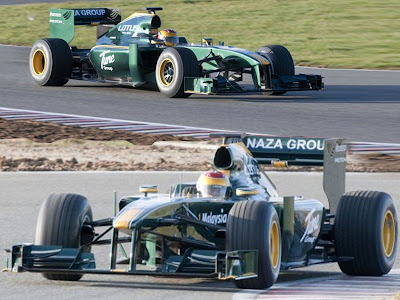
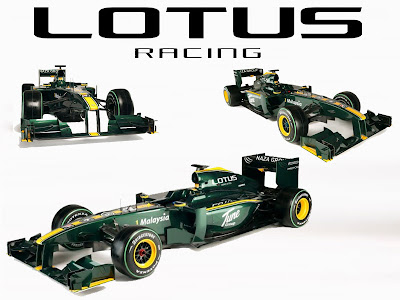
Lotus has just unveiled its 2010 Formula 1 car, after 15 years one of the most successful names in Formula One returns to the grid with the launch of the Lotus T127. Backed by the Malaysian government, the new Lotus team will field two cars, driven by Jarno Trulli and Heikki Kovalainen. Lotus the T127 will be one of several cars using the latest Cosworth V8 this year.
 Lotus Sport Cars T127 Formula One
Lotus Sport Cars T127 Formula One
2010 Lotus Sport Cars T127 Formula One Racing is backed by the Malaysian Government - where Lotus owner Proton is based - securing the rights last year to the team's name and legendary green and yellow colours. Mike Gascoyne, technical chief for the T127, admitted the car was designed very quickly, the team revealing its car mere weeks ahead of the 2010 Bahrain F1 Grand Prix.
 Lotus Sport Cars T127 Formula One
The Lotus T127 is powered by a Cosworth engine - another name returning to the sport cars after an extended absence - and will use an Xtrac transmission, in line with all 2010 teams, will be running on Bridgestone tyres.
 Lotus Sport Cars T127 Formula One
Lotus Sport Cars T127 Formula One

Paris 2010: Lotus Esprit Concept previews upcoming revival of a legend

Paris 2010: Lotus Esprit Concept

Lotus is ready to make a big impact at the 2010 Paris Motor Show. It brought five concept vehicles to the show (more on the other four in short order), and one in particular has us salivating. Lotus plans to revive the much-loved Esprit for the 2013 model year. Before we see a production version of that car, the automaker is showcasing its Lotus Esprit Concept.

Taking cues from the old Esprit, the Esprit Concept plunks its engine amidship, though instead of honoring the turbocharged four-cylinders that powered the originals, the concept makes do with a meaty supercharged 5.0-liter V8. That V8 will look familiar to fans of the Lexus IS-F. The two-seater will produce 620 horsepower, accelerate from 0-60 in under 3.5 seconds and then blast onward to a 205-mile-per-hour top speed. The plan is to bring the production version to market in the spring of 2013 with a price tag around $175,000.

In addition to the massive, and massively exciting ,V8 power, the Lotus Esprit will also be offered with KERS as an option. KERS, or Kinetic Energy Recovery System, is a system used by Formula 1 cars to recover heat energy generated during braking. The energy is stored until the driver wants a powerful boost and with a push of a button propels the car with more force than two bottles of NOS... the big ones.

Paris 2010: Lotus Elise Concept evolves the sports car

2015 Lotus Elise Concept

There's no denying that Lotus had lost its way prior to the release of the much-loved Elise. The company that Colin built had strayed from its roots of lightweight sports cars and drifted towards the exotic realm... and it had drastic effects on the company's bottom line. Thankfully, the Elise and its hard-core cousin, the Exige, set the company back on the straight and narrow.

All of this begs the question, though: How do you update a modern classic like the Elise? Lotus' answer is currently being shown off at the Paris Motor Show. Here are the basics: 320 horsepower from a turbocharged 2.0-liter four-cylinder engine procured from Toyota, a six-speed manual and optional paddle-shifted automatic transmission, and a 2,409-pound curb weight. This supercharged model can hit 62 in 4.3 seconds. Price? $55,000.

For those keeping track of such things, which is to say nearly all of you, that is indeed heavier and more expensive than the current Elise... and that's not good. Fortunately, Lotus promises that there will be less expensive versions of the 2015 Elise available, presumably without the benefit of forced induction. There will also be both hard-and soft-top models on offer.

What all Elises will offer, though, is a more luxurious cabin and easier entry and exit. We're loving the look of the interior, with its pod-like binnacle of instruments, steering wheel with F1-style progressive shift lights and its digital rendering of race circuits for those venturing out the the track. As for the exterior, well, let's just say we're not quite on board yet with what Lotus designers have planned for the brand's future. Fortunately they have plenty of time to change our minds.

Paris 2010: Lotus debuts Eterne hybrid sedan concept


When we think of Lotus, the words "hybrid" and "sedan" aren't exactly the first words that come to mind. Now, though, Lotus is changing all that with the introduction of its Eterne concept, a four-door sedan with an optional hybrid powertrain. This may be a big step in a different direction for Lotus, but it's nothing new. The Eterne takes the same shape as the Porsche Panamera, Aston Martin Rapide and Audi A7 Sportback.

Like the new Esprit concept, the Eterne is powered by a 620-horsepower, 5.0-liter V8 sourced from Toyota. The optional hybrid drivetrain uses a Formula 1-style KERS energy recuperation system, and the Lotus sedan will be available in both rear- and all-wheel drive. Of course, this is still a Lotus, so good performance numbers are an absolute must, and we're told that the Eterne will run to 60 miles per hour in just 4.0 seconds on its way to a top speed of 196 mph.

While merely a concept at this point, Lotus says that the Eterne is slated for production in 2015 and that the sedan will cost around $190,000.

Paris 2010: Lotus Elan Concept stuns the crowds

2013 Lotus Elan Concept

We didn't see this one coming. Lotus' five-car concept explosion at the Paris Motor Show is one of the most welcome surprises sprung on us in recent memory... and the biggest surprise of all may be this Elan. Lotus says its new Elan is slated for a debut in 2013, which makes us wonder what the future may have in store for the current Evora. Pricing for the 2013 Elan is set at $118,500 (�75,000).

In any case, the Elan is powered by a 450-horsepower supercharged 4.0-liter V6 engine with a seven-speed dual-clutch gearbox from Toyota, which offers enough gumption to scoot to 62 miles per hour in just 3.5 seconds and on to a top speed of 193 mph. Lotus also promises that a hybrid will be available using a Kinetic Energy Recovery System similar to those seen in Formula One a season ago.

Take a good look at the awesome cockpit of the 2013 Elan. Plenty of carbon fiber, plenty of high-tech goodies, even including a digital race track readout for track days. And could anything be better than that awesome flat-bottom and flat-top steering wheel? No, we didn't think so.

Weight comes in at 2,849 pounds and there is room for a driver and a passenger, but Lotus will also optionally deliver the Elan with two itty-bitty perches out back.

Paris 2010: Lotus shows off its new Grand Tourer, the Elite

Lotus Elite Concept

Lotus continues its march towards global sportscar domination with the 2010 Paris Motor Show unveiling of the Lotus Elite. The Elite represents a step away from "lighter is better" because it is a hefty, four-passenger grand tourer � it weighs in at 3,600 pounds. One of the reasons it's so heavy? It has a retractable, folding hardtop. Don't let the weight throw you off though, this is a good looking, aggressively styled powerhouse. Under the hood sits a modified version of the 5.0-liter V8 out of a Lexus IS-F. The unit is then massaged to produce 611 horsepower which propels the car to a sub-four-second 0-60 time and a top speed of 195 miles per hour. The Elite will also be fitted with KERS for a quick boost of recovered energy.

The front mid-engine layout should help balance the Lotus Elite and make for an exciting driving experience. We expect this car to represent a slightly softer side for the automaker, but that's like saying we expect a bomb to hurt less than a missile. The entire Lotus lineup is poised in attack position, the Elite just happens to wear clothes from the Big and Tall store.

Lotus is aiming to bring this sporty road warrior to market sometime in the year 2014. If you invest your money wisely now, you just might be able to save the estimated $180,000 you'll need to put one in your driveway.

2014 Lotus Elite

Lotus

Lotus� plan of reinventing its brand after years of mediocrity is looking less and less like wishful thinking after the company officially released initial details of their future hybrid supercar, the 2014 Elite.

It�s been widely known that the British sports car maker is aggressively pushing to remake their entire portfolio to cater to a more upper echelon consumer base and if everything goes according to plan, the 2014 Elite should be the first of many aggressively designed sports cars the company is looking to introduce to the market.

Word has it that the Elite will be powered by a 5.0-liter V8 engine that produces around 500-plus horsepower with a 0-60 mph time of around 3.5 seconds and a top speed of just under 200 mph at 196 mph. If these numbers are anywhere close to what the production version of the Elite will be capable of, then you can expect the supercar, with the aggressive backing of the company, to be a player in a market long dominated by the likes of Aston Martin, Audi and Porsche. Even the car�s expected price tag - �115,000 � is right up there with the Porsches of the world.

As for the new � and aggressive � design of the car, the man behind it, designer Donato Coco, left no stones unturned in giving the Elite a more aggressive approach by adding some depth to the car�s front fascia. As somebody who noted the two-dimensional looks of prior Lotus vehicles, Coco�s design of the Elite is about as good as it can get for a brand looking to be edgier and more upscale that what its previous reputation suggests.

Lotus Exige Cup 260 (2008)

Lotus Exige Cup 260 (2008)
The Lutus Exige Cup 260, once again represents Lotus' most radical version of the Exige, with the track environment being its home and for 2008.A direct development of the 2007 Exige Cup Car, this year's car has a revised engine management system to take the maximum power output to 257 hp (260 PS), up by nearly 5 hp (5 PS) over last year.The Lotus Sport Exige Cup 260 is one of the quickest cars around a circuit. Key to this incredible performance is the aerodynamic package, which produces over 40 kg of downforce at 160 kmh increasing grip and stability at higher speeds. With a top speed of 247 kmh (147 mph) and a zero to 160 kmh (100 mph) in circa 9.9 seconds, 0 to 100 kmh in circa 4.1 seconds (0 to 60 mph in circa 4 seconds), the MY2008 Exige Cup 260 is the perfect partner for the serious racer. Combined Fuel Consumption is 9.1 l/100km and the CO2 emissions 216 g/km.

Lotus Ice Vehicle Concept, 2008

Lotus Ice Vehicle Concept, 2008


Lotus Ice Vehicle Concept, 2008

The Car That Could Solve Everything: European 2011 Lotus Elise S rated at 46.7 mpg

2011 Lotus Elise


Particularly given its performance capabilities, the Lotus Elise has always been remarkably fuel efficient. The Elise (and its hardtop Exige sibling) have long been a rolling testament to the benefits of light weight. Thanks to a new 1.6-liter, 136 horsepower inline-four and a new lower drag nose, the European-spec 2011 Elise S is now officially rated at 46.7 miles per gallon (U.S.) on the EU highway cycle, and the carbon dioxide emissions are just 149 grams per kilometer on the combined cycle.

The CO2 number makes the Elise S the cleanest gas powered sports car in the world, and all without resorting to redundant powertrain hardware like electric motors and batteries. While sipping fuel and minimizing emissions, the Elise S still promises to rip off a 0-60 mph sprint in just six seconds and handle like a dream. That's what a 1,931 pound curb weight will buy you. Alas, Americans will not be able to buy the 1.6-liter Elise S, as the entry level model here will remain a 190-hp 1.8-liter rated at 21/27 mpg by the EPA.


[Source: Lotus]

Lotus Hot Wheels Concept, 2007

Lotus Hot Wheels Concept, 2007


To celebrate its 40th anniversary next year, Hot Wheels approached Lotus and other world leaders in he automotive industry with the challenge for each company to produce a vehicle that embodies its own engineering philosophy and brand.


Lotus Design's international reputation for designing visually dynamic and exhilarating sports cars perfectly fitted the brief for this programme and we relished the opportunity to design a concept that was free from the typical technical and legal constraints of a full size car.
The car needed to be recognisable as a Lotus without having to turn it over to look at the badge underneath, so.  Bold aerodynamic aids are incorporated to achieve exceptional Lotus handling. The top exit radiator at the front, a distinctive Lotus design feature, the rear diffuser and a large rear wing all provide down-force helping the vehicle stick to the road. In addition, large side air intakes and an open rear end aid engine breathing. Inside the car, the exposed centre spine is part of the structure and incorporates the switches and gear linkage and supports the rear wing."

Lotus Design has a global reputation and is responsible for the design of all Lotus cars, including Lotus Europa, Exige and iconic Elise and many designs for our engineering clients globally. The same design team who created this stunning concept is also designing our new range of cars, the first of which, codenamed Project Eagle, will go into production at the end of next year."


Geneva 2010: Lotus Evora 414E Hybrid Concept mixes old and new

Lotus Evora 414E Hybrid Concept

We got sneak peek of the first ever Lotus Hybrid a couple of days ago, and now we've seen the Evora 414E Hybrid in the metallic flesh. Just a slight refresher on the technology, the 414E makes 408 horsepower and a skull-popping 590 pound-feet of torque via electricity.

That's right, this is not your Prius-style hybrid. Like Chevy's Volt, the Evora 414E is an extended-range electric vehicle. Meaning that it runs on batteries (for up to 35 miles) before a 47-hp three-cylinder engine kicks on to provide power. Also, instead of one electric motor, the 414E has two. One for each rear wheel. And since most of the time the car will be running off lithium-ion batteries, Lotus is employing HALOsonic Internal and External Electronic Sound Synthesis systems to make the 414E sound like a "real" car.

On the outside, the 414E looks like your "standard" Evora, except that this here show car is covered in faux-electric circuitry. Plus it's painted in a gorgeous shade of matte copper. The real story though, is inside. Talk about Black and Gold! Even if the Evora 414E Hybrid never makes it to production (we hearing it will in two to three years) we hope they offer those seats as an option. Yes, we're odd people. Deal with it.

Tokyo 2009: Lotus Exige Stealth

Lotus Exige Stealth

Lotus has unveiled the latest special edition of its maximum performance, minimum everything else Exige today at the Tokyo Motor Show. We took a moment to check out the Exige Stealth (known as the Scura in Europe) on the show floor and managed to curry some time with Lotus vehicle development director Roger Becker.

The new model gains a set of comely forged alloy wheels, but the big news with the car is the unique paint. We asked Becker about the Stealth and its special finish, and as it turns out, this is more than just a basic matte paint. Lotus has been experimenting for several years with matte finishes but was never satisfied with the results. The problem � as anyone who has ever done body repairs and worked on primer-finished cars can tell you � is that matte surfaces really show marks and stone chips. Lotus wanted something more durable before putting the car into production.

To create the Exige seen here, the entire car has to be sprayed in the base gloss coat seen on the central stripes. The stripe area was then masked off and the rest of the body abraded in order to get a surface that the matte paint will grip to. Finally, a newly formulated rubberized matte paint is applied. When you touch the car, the surface actually feels soft, and according to Becker, it is four- to five-times more resistant to marking and peeling than other finishes.